
By Glo Chitwood , Kayak Adventures Guide
“Neuroscientists have something to say about origin moments. When we experience things for the first time, our brains, like inner diarists, ‘write’ furiously, recording even the smallest details: a blue sweater, curled orange peels, the tang of salt air on our lips. That’s why we remember firsts so vividly, experience them, decades later, ‘like it was yesterday.’”
Eva Saulitis, Into Great Silence
The sweet spot at Aialik Glacier
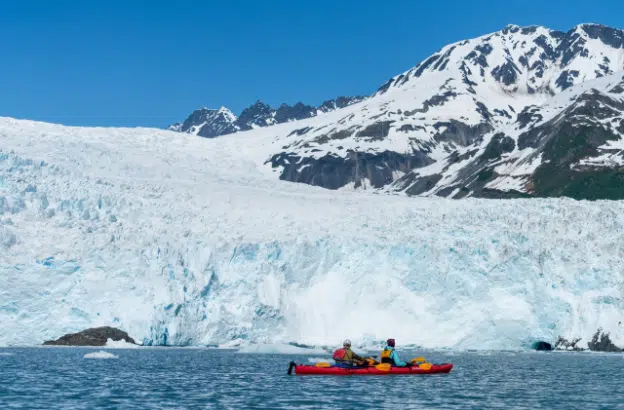
There is always a moment on a trip to Aialik Glacier where we kayak through the ice, mindlessly chatting, and then suddenly we are just there. The sweet spot. It is almost as if we forget to look up and when we do, a mile-wide, 300-foot tall piece of history is living and settling and creaking before us, patiently waiting for us to notice.
Almost every time, in that moment, everyone falls silent.
Sharing a first
We no longer feel like visitors in these moments. We are suddenly so small, just another species in the system taking up space on Earth in the way we know how. On all sides, grey and blue ice floes provide a quiet place to rest for harbour seal pups. They are wary of us but their minds are open. While the adults have learned to drone out the thunder of ice breaking off the glacier and falling into the water, sometimes the pups startle and flush into the ocean. They are still learning what to be afraid of.
Floating in silence together, we share a first.
Why firsts matter for kids
It is especially impactful to share these moments with families with young children. The way kids process information with curiosity and without bias makes them excellent candidates for conservationists.

Origin moments that shape us
Why, when I think about the first time I went camping, the first time I caught a fish, or the first time I walked to the edge of the ocean in a pudgy infant swimsuit, do I get such a sentimental look in my eyes?
These are my origin moments. They are crystal clear, while things I probably should recall easily, like where I parked my car or why I walked into this room, elude me daily. I attribute these moments to the person I am, and to why I care about protecting natural spaces so others can have the same positive experiences I was and am lucky to have.
Origin moments are special because our brains are fully open to new information: what we see and hear, and most importantly how we feel as we take in the new data. When working with young people, it matters to associate their origin moments with positive feelings, putting kindling on the fire of their curiosity and fuelling their desire to protect the vulnerable.
The questions kids ask
Children ask the best questions, often stumping their guide and giving me a new perspective on what young people are thinking about and worried about. They are smart. They know they are on deck to be adults. They have a stake in this Earth too.
Why is the glacier calving? Is it our fault? Is this climate change? Why are some killer whales talkative and some quiet? Does the boat’s motor hurt whales’ ears?

Finding answers together
Often there are no perfect answers. We get a chance to discuss and discover ways to better care for the natural world together. Kids are not afraid to be critical and curious. Sometimes, when we talk about these things, I see their parents lean in to listen. They want answers too. I wish answers were easy. We often talk about how to be better environmental stewards and how to give whales space so the motor is not too loud.
Facing the fjords with clear eyes
When I work in the fjords, I face tough realities as we sit in front of ground zero of climate change. I cannot ignore its impacts or fail to mention them. When I see a child consciously forming an opinion and an action plan to preserve the details of their origin moment, I see a harbour seal pup: young, unadulterated, and unafraid of asking difficult questions.
They have not been taught to ignore the calving ice yet.

